



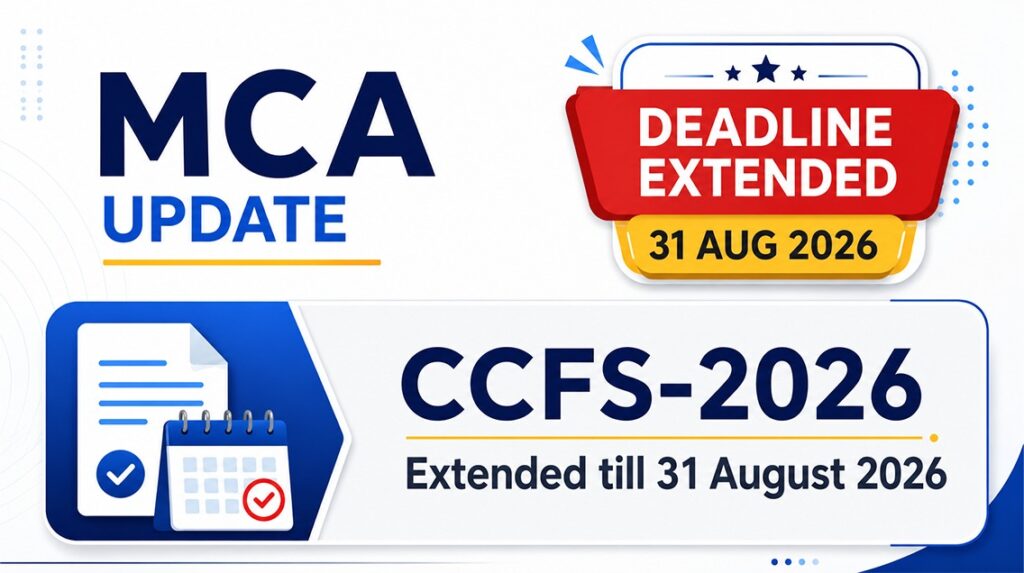
If your company has pending annual filings with the Registrar of Companies, this update matters. The Ministry of Corporate Affairs has extended CCFS 2026, and companies now have until 31 August 2026 to use the relief this scheme offers. This guide explains the CCFS
We are now five months into FY 2026-27, and this is usually the point where the gap between what a company actually does and what its corporate records say becomes visible. Directors join and leave, registered offices shift, share capital gets allotted, charges get created and satisfied, and none of it means anything under company law until it is reflected correctly in the company’s corporate records and statutory registers. If you have not looked at your statutory registers since April, this is a good time to do it.
This blog walks through what corporate compliance actually requires when it comes to record maintenance, where companies typically fall behind, and how to bring your corporate records back in line with your business.
What Corporate Records and Statutory Registers Actually Cover
Under the Companies Act, 2013, every company registered in India, private or public, is required to maintain a defined set of statutory registers under Companies Act 2013 at its registered office. Section 88 of the Act is the primary provision governing this, and it applies regardless of company size, though certain relaxations exist for small companies. Corporate record maintenance is not optional paperwork. It is a legal requirement and forms the backbone of Company Secretarial Compliance.
The commonly required statutory registers include:
- Register of Members, maintained in Form MGT-1
- Register of Directors and Key Managerial Personnel, along with their shareholding
- Register of Charges, covering all secured borrowings
- Register of Debenture Holders, where applicable
- Register of Renewed and Duplicate Share Certificates
- Register of Deposits, to be maintained for eight years from the relevant financial year
- Register of Significant Beneficial Owners
- Register of Loans, Guarantees, Security and Investments under Section 186
- Register of Contracts and Arrangements in which directors are interested, under Section 189
- Register of Employee Stock Options, where an ESOP scheme exists
Not every company needs every register. Corporate Compliance in India works on an applicability basis, meaning a register only becomes mandatory once the underlying event, such as a charge creation or an ESOP grant, actually occurs.
Where the Mismatch Usually Happens
The problem most businesses run into is not that they never maintained corporate records. It is that the records were correct at the last update, quite possibly at the previous financial year end, and the business has moved on since. A few common places where corporate records fall out of step with Company Secretarial Compliance requirements:
- Director changes not reflected in the Register of Directors and KMP, particularly when a director resigns and the company continues to show them as active
- New share allotments not updated in the Register of Members within the prescribed timeline
- Charges created on new borrowings not entered in the Register of Charges, even though the charge itself was correctly filed with the ROC
- Registered office changes not carried through to statutory registers even after the MCA master data is updated
- Related party contracts entered mid-year and never logged in the Register of Contracts
Each is a small gap on its own, but statutory registers are checked as a set during due diligence and audits, so small gaps in corporate compliance compound quickly.
Why This Matters
Failure to maintain statutory registers correctly is a compliance default with a fixed monetary cost, not just an administrative lapse. Under Section 88(5), as substituted by the Companies (Amendment) Act, 2020, a company that fails to maintain its register of members, debenture holders, or other security holders is liable to a penalty of Rs 3 lakh, and every officer in default is liable to Rs 50,000. This default was decriminalised in 2020, so imprisonment no longer applies here. It is sometimes confused with the separate Section 128 penalty for failing to maintain books of account, which carries a different fine structure and, in more serious cases, imprisonment. The two are not interchangeable.
Beyond the direct penalty, incorrect corporate records tend to surface at the worst possible moments, during a funding round, an acquisition, or a bank loan sanction, when a lender or investor’s due diligence team checks statutory registers and corporate records against actual business activity and finds discrepancies.
How to Reconcile Corporate Records with Business Changes
A practical exercise for this point in the FY is to pull every statutory register out of the file and check it against three things: your latest MCA master data, board resolutions passed in the last six months, and your bank and lending documentation.
Start with the Register of Directors and KMP and confirm it matches the DIR-12 filings on record. Check the Register of Members against every allotment or transfer this year, and the Register of Charges against every loan or facility sanctioned in the period. If your company has issued or modified an ESOP scheme, confirm the Register of Employee Stock Options is current.
This is how to maintain corporate records under Companies Act 2013 in practice: not a one-time setup exercise, but a running reconciliation tied to actual business events. Companies that treat statutory registers as a live document, updated as events happen rather than backdated at year end, rarely face compliance surprises.
FAQ's
How do I maintain corporate records under the Companies Act 2013?
Corporate records must be updated at the registered office as soon as the relevant event occurs, such as a share allotment, a charge creation, or a change in directorship, rather than in a single annual exercise.
How do I check statutory registers and company records for compliance?
Compare each statutory register against its source document. Match the Register of Members against allotment and transfer records, the Register of Directors against DIR-12 filings, and the Register of Charges against loan sanction letters and ROC filings.
How do I reconcile corporate records with business changes in India?
Review every business event from the financial year, director changes, capital changes, borrowings, related party transactions, and confirm each is reflected in the corresponding statutory register.
Are statutory registers mandatory for private companies?
Yes. Corporate Compliance in India applies to private companies as much as public companies, with the same statutory registers required unless a specific exemption applies under the small company relaxations.
What happens if statutory registers are not maintained?
Under Section 88(5), the company can face a penalty of Rs 3 lakh, and every officer in default can be penalised Rs 50,000. This is a fixed monetary penalty, and imprisonment does not apply to this specific default following the 2020 amendment.
Conclusion
Five months into FY 2026-27 is a reasonable checkpoint, not a deadline in itself, but if your business has grown, raised capital, or changed leadership since April, your corporate records need to reflect that now rather than at year end. Treating corporate compliance as an ongoing habit, not an annual scramble, is what keeps statutory registers audit-ready all year and far less expensive to fix than a retroactive correction during due diligence.
Disclaimer
This article is for general informational purposes only and is based on the Companies Act, 2013 and related rules as publicly available at the time of writing. It does not constitute legal advice. Applicability of specific registers, thresholds, and penalties can vary by company type and circumstance. Please consult a qualified company secretary or corporate lawyer before making compliance decisions based on this article.
